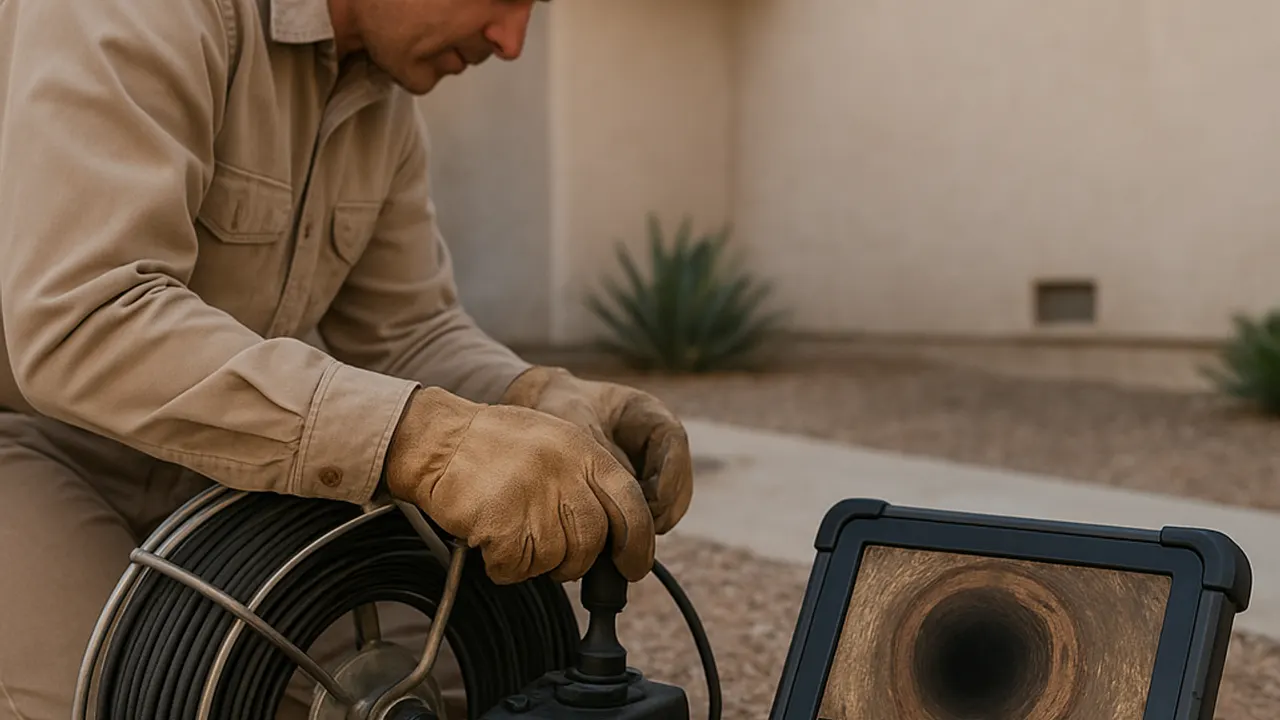
To read a sewer camera inspection report, match each written finding to its location in the pipe, review the video at that spot, and judge the defect by its effect on drainage-not by the label alone. Then compare the recommendation with the visible evidence, pipe material, and any recurring backups. A useful report lets you see what was inspected and why a repair, cleaning, or follow-up is proposed.
How to read a sewer camera inspection report is a practical guide to interpreting recorded pipe footage and its findings so you can decide what your Whittier property needs next. We explain the report sections, distance markers, common damage terms, and questions worth asking before work begins.
A sewer camera report is a recorded plumbing diagnostic document that shows the pipe's interior, identifies observable defects, and helps determine the next step when a drain repeatedly clogs, backs up, or shows signs of damage. At Aron Leakage Master, we use the footage to connect symptoms to a specific point in the line rather than relying on guesswork.
What a sewer camera report tells you
A sewer camera report for a Whittier property connects the video, pipe location, observed condition, and recommended action in one record. Start with the summary, but do not stop there; the footage and notes should support the conclusion.
Look for the inspection's starting point and endpoint. The camera may enter through a cleanout, a drain opening, or another access point, and the report should identify the route examined. A line described as "inspected to 65 feet" is not the same as a line inspected all the way to the municipal connection.
Distance is usually measured along the camera cable from its entry point. A defect at 18 feet means 18 feet from that access point, not necessarily 18 feet from your property line. Ask us where the camera was inserted and which direction it travelled so you can relate the measurement to your yard, slab, or driveway.
Our Sewer Camera inspection Whittier CA work is centered on giving you usable visual evidence, not just a list of alarming-sounding terms. For a typical residential line, the report should make clear whether the concern is a small deposit, a recurring obstruction, or a structural defect that affects the pipe's ability to carry wastewater.
What information is included in a sewer camera report?
A complete sewer camera report for a Whittier home includes the inspection route, video or images, distance markers, pipe observations, and a recommendation tied to the evidence. Those details let you understand what the camera actually showed.
Read the report in this order: inspection details first, location notes second, observations third, and proposed next steps last. If the report has only a short conclusion and no video, location, or description of the finding, you do not have enough context to assess the recommendation.
- Inspection details: Date of inspection, access point, direction of travel, and the section of line reached.
- Pipe details: Material and approximate diameter, when visible or known; common residential pipe diameters include 3 and 4 inches.
- Findings: A plain-language note describing the issue and its distance from the camera entry point.
- Evidence: A continuous video, still images, or both, with timestamps or distance overlays where available.
- Next step: Whether the line needs monitoring, cleaning, further inspection, or repair.
A sewer line video inspection report guide should also help you orient yourself. Look for whether the camera reached the public sewer connection or stopped at a blockage, standing water, or a bend. A blockage can prevent the lens from showing what lies farther down the line, so the unviewed section should be stated plainly.
When the concern involves the building's main drain, a Main sewer line camera inspection Whittier CA can help locate the source of repeated whole-house backups. In Whittier, tree roots, older pipe materials, and changes in ground conditions can all influence what the camera records, but the footage should identify the actual condition rather than assume its cause.
How to understand roots, cracks, and offsets
Roots, cracks, and offsets in Whittier sewer footage describe different pipe conditions, and their seriousness depends on how much they obstruct flow or compromise the pipe. Use the image and the inspector's location notes together.
Roots appear as fine strands, hair-like growth, or a dense mass crossing the pipe. Fine roots entering through a joint can catch paper and debris, leading to repeat clogs; a thick root ball can nearly close the passage. The report should state whether roots are minor, moderate, or obstructive and whether the camera could pass the area.
Cracks are visible breaks or separations in the pipe wall. A hairline crack without displacement is different from a wide opening with soil visible beyond it. Ask whether the camera shows an active leak path, missing pipe material, or a crack that has changed the pipe's shape.
An offset is a mismatch between adjoining pipe sections. The joint may have shifted vertically, horizontally, or both, leaving a lip where waste can snag. A small offset that still allows smooth flow is not equivalent to a joint with a pronounced ledge or an open gap.
Other report terms also matter. "Standing water" means the camera sees water pooled in a section; it can point to a low spot or a flow restriction, but one image alone does not prove a broken pipe. "Scale" or "deposits" describes material attached to the inner wall, while "belly" usually refers to a sagging pipe section where water collects.
In older streets and established residential areas, including the Sewer Camera inspection in Whittier Historic District area, knowing the pipe material and the exact defect location helps put footage in context. The camera shows interior condition; it does not automatically establish the age, cause, or full exterior extent of damage.
How to interpret a sewer pipe inspection recommendation
A sewer repair recommendation for a Whittier property makes sense when the proposed work addresses a documented defect and the report explains how that defect affects flow or pipe integrity. Compare the recommendation with the video before deciding.
"Clean and reinspect" is often appropriate when roots, grease, or mineral buildup obscure the pipe wall. Cleaning removes the obstruction; a second camera pass can then show whether the pipe underneath is intact. If the recommendation is to replace a section, look for the defect's measured location, visible severity, and reason a less extensive step would not resolve the problem.
These phrases commonly appear in sewer pipe condition report terminology:
- Monitor: The finding is visible but does not currently justify repair; keep the footage and compare it if symptoms return.
- Clean: Remove roots or deposits that restrict flow, then confirm the camera can pass and inspect the pipe wall.
- Spot repair: Repair a defined damaged section rather than replacing the full line.
- Line rehabilitation or replacement: Address broader deterioration, repeated structural failures, or damage that a localized repair will not solve.
Interpreting drain pipe inspection results also means separating the observation from the proposed solution. "Roots at 32 feet" is an observation; "replace 40 feet of pipe" is a recommendation. Ask what footage supports the length and method, and whether the camera inspected beyond the root entry point.
If a recommendation involves cleaning before another assessment, our Hydro jetting Whittier CA service can clear suitable obstructions so the pipe can be viewed more clearly. Cleaning is not a structural repair, so a crack, separated joint, or severe offset still needs its own plan.
For typical 2026 pricing in the area, a straightforward residential camera inspection often falls around $150-$400; added access work, difficult blockages, or a larger commercial line can change the total. We explain the inspection cost upfront so you know what the service covers before the camera goes into the line.
Common mistakes when reviewing sewer footage
Homeowners in Whittier most often misread sewer footage by treating one image as a complete diagnosis or assuming every visible imperfection requires immediate replacement. Review the whole pass and the report's limitations.
A camera view can be disorienting: water, glare, pipe bends, and debris can make a minor feature look severe. Pause at the timestamp or distance noted in the report, then ask the inspector to explain what is in frame and whether the lens was moving or stationary.
Watch out for these common reading errors:
- Assuming the distance marker measures from the street or property boundary instead of the camera entry point.
- Confusing a temporary blockage with a damaged pipe that needs replacement.
- Taking "roots present" to mean the entire line must be replaced.
- Ignoring a limitation note that says the camera could not pass a blockage or submerged section.
- Accepting a repair length without comparing it to the footage and marked defect location.
Also check whether the report identifies the line that was inspected. A kitchen branch drain, a building sewer, and a private lateral are different sections. If your home has multiple cleanouts, one camera run may show only part of the drainage system.
Keep the original video, not just a screenshot or a verbal summary. If symptoms recur months later, comparing the footage with a new inspection can show whether roots returned, a deposit grew, or a structural issue changed.
When to call a professional
Call a sewer camera professional in Whittier when several fixtures back up together, a clog returns soon after clearing, or a report identifies an obstruction or structural defect. Those signs point beyond a single slow sink.
One isolated slow drain can come from a local trap or branch line; a toilet, shower, and laundry drain backing up at once suggests a shared downstream section. Sewage coming up through a floor drain, repeated gurgling, or a strong sewer odor also deserves prompt attention.
At Aron Leakage Master, we explain the footage in plain language, point out where the camera stopped, and connect each recommendation to what we saw. If you have a report from another inspection, we can help you understand its terminology and determine whether additional camera evidence would clarify the next step.
Before you approve a repair, ask these practical questions: Where was the camera inserted? What distance marks the defect? Did the lens pass the affected area? Can you show me the video segment? What problem will the recommended work correct? A clear answer should refer to a location or visible condition, not rely on a vague warning.
Frequently Asked Questions
What information is included in a sewer camera report?
A sewer camera report includes the access point, inspected route, distance measurements, pipe observations, video or images, and recommended next steps. Check whether it states how far the camera travelled and whether it reached the connection. A report should also disclose areas the camera could not inspect because of water, blockage, or access limits.
What do roots or offsets mean in an inspection report?
Roots show plant growth entering or obstructing the pipe, while an offset means two pipe sections no longer align evenly. Either can catch waste and contribute to repeat clogs. The report's distance, footage, and description of the obstruction's size help determine whether cleaning, monitoring, or repair is appropriate.
Should I receive video with my sewer line report?
Yes, you should receive video or clear visual documentation of the inspected section. A continuous recording is more useful than a single still because it shows the camera's path and what lies around a defect. Make sure you can match any written finding to a timestamp or distance marker.
How do I know if a sewer repair recommendation is necessary?
A repair recommendation is better supported when the report shows a specific defect, gives its location, and explains how it affects drainage or pipe integrity. Ask to review the relevant footage and whether cleaning or a follow-up inspection would reveal more. A blocked view is not proof that the unseen pipe needs replacement.
Can another plumber review my sewer camera footage?
Yes, another plumber can review your footage and report, especially if you have the original video and distance notes. Share the symptoms, the camera entry point, and any prior cleaning records. A second opinion is most useful when the reviewer can see the full pass rather than a cropped clip.
Get help with Sewer Camera inspection in Whittier
If your sewer report leaves you unsure about roots, damage, or a proposed repair, Aron Leakage Master can walk you through the footage and explain the next practical step. Call 5625880964 to discuss a Sewer Camera inspection in Whittier.